If you’ve searched for help with tight hips, stiff shoulders, or a body that won’t loosen up no matter how much you stretch on your own, you’ve seen two phrases used almost interchangeably: fascial stretch therapy vs assisted stretching. They’re not the same thing. Fascial Stretch Therapy (FST) is a specific, fascia-focused method I practice at VCan Fitness in Brentwood, TN. “Assisted stretching” is the bigger umbrella term covering FST plus several other methods. Here’s the real difference, so you can choose the right one for your body.
What Is Fascial Stretch Therapy (FST)?
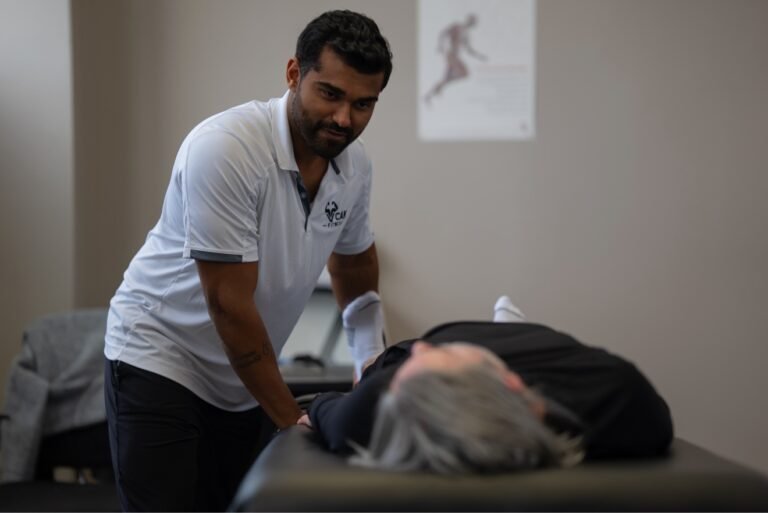
Fascial Stretch Therapy is a practitioner-assisted method developed at the Stretch to Win Institute, and I’m a Certified FST Practitioner — Level 2. You’re on a table, fully clothed, and I move your body for you through waves of motion — gentle, rhythmic movement through your hips, shoulders, spine, and legs.
Three things make FST its own method rather than just “stretching with help”:
1. Traction before movement. Before I take a joint into a stretch, I gently traction it — creating a little space in the joint first. That tells the nervous system the joint is safe, so your body doesn’t fight the stretch the way it does when you yank yourself into a deep lunge on your own.
2. Working with the stretch reflex, not against it. Your body has a built-in guard called the stretch reflex — the “seatbelt” that snaps muscles tight when you hit a stretch too fast. That’s why you can stretch every morning and still feel just as tight by afternoon. FST’s slow, wave-like motion keeps that reflex quiet, so the muscles and fascia around it can actually let go.
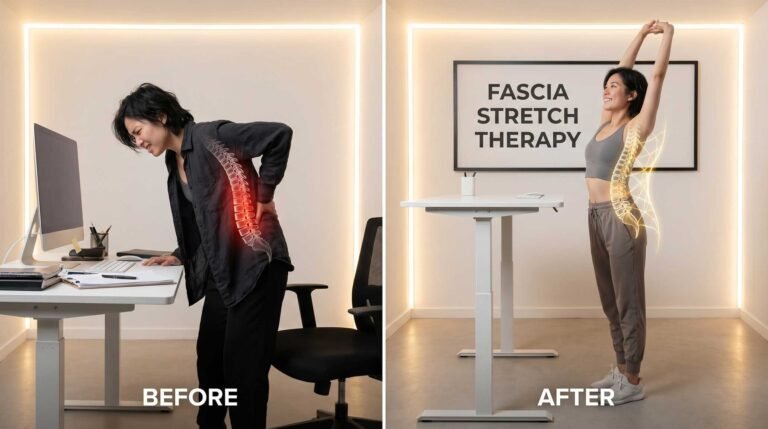
3. Fascia first. Fascia is the continuous web of connective tissue wrapping every muscle, joint, and organ. When it stiffens from desk work, hard training, or years in the same posture, everything it wraps feels tight. FST is built for how this tissue behaves — it responds to slow, sustained, multi-directional movement, not forceful pulling. Published research on the method has reported range-of-motion improvements of 4 to 31% after FST sessions.
What Do People Mean by “Assisted Stretching”?
“Assisted stretching” is the generic name for any stretching where someone else moves your body for you instead of you doing it yourself. It covers a lot of territory, and that’s exactly why the phrase causes confusion. The main methods you’ll run into:
- Fascial Stretch Therapy (FST) — the fascia-focused method I described above. Certified practitioners, traction-based, nervous-system friendly. This is what I offer at VCan Fitness.
- PNF stretching — proprioceptive neuromuscular facilitation. This is the method behind StretchLab’s sessions: you contract a muscle against resistance, then relax into a deeper stretch. It’s one of the most studied assisted-stretching methods.
- Proprietary studio methods — Stretch Zone, for example, uses its own patented strapping system and calls its work “practitioner-assisted stretching.” Their Brentwood studio advertises a free first stretch.
So when someone asks “is fascial stretch therapy the same as assisted stretching?” — FST is assisted stretching, the same way a square is a rectangle. But not all assisted stretching is FST. The method underneath the label is what matters.
Fascial Stretch Therapy vs. Assisted Stretching: Side by Side
| Fascial Stretch Therapy (FST) | Other assisted stretching methods | |
|---|---|---|
| Core idea | Traction + slow wave-like motion targeting the fascial system | Varies: PNF uses contract-relax cycles; studio methods use their own protocols |
| Stretch reflex | Kept quiet, so tissue can release | PNF uses it deliberately (contract, then release deeper) |
| Intensity | Gentle — most clients feel deeply relaxed | Ranges from gentle to fairly intense by method |
| Format at VCan | Private 1-on-1 on a table, 30 or 60 minutes | Varies; some studios use group or open-floor formats |
| Training | Certified via the Stretch to Win Institute (I’m Level 2) | Varies by studio — ask where your practitioner trained |
| Best known for | Deep, lasting looseness; the “fascia release” feeling | Flexibility gains, athletic mobility, recovery |
Neither approach is “better” in the abstract — but they feel different. People who tell me “stretching never worked for me” usually tried the forceful kind, where their body fought the whole time. FST takes the opposite route: convince the nervous system it’s safe first, and the range of motion follows.
FST vs. PNF Stretching — and Is FST Better Than Massage?
FST vs. PNF: PNF is well-researched and produces real flexibility gains — the difference is approach. PNF asks your muscles to work (contract against me, then relax deeper). FST asks your nervous system to let go (traction, gentle oscillation, no forcing). If you like an active, athletic-feeling session, PNF may suit you. If you want to lie on the table and let the fascia system unwind, that’s FST’s lane.
Is FST better than massage? Different tool, different job. Massage works through pressure on the muscles — great for sore, overworked tissue. FST works through movement: I take your joints through their ranges while tractioning them, addressing the tightness that lives in your movement patterns, not just sore spots. Many clients do both — massage for recovery days, FST for mobility days.
Which One Should You Choose?
Ask yourself what you’re actually after:
- Choose FST if you’ve been stretching for years without lasting change; if your tightness feels like it’s everywhere, not in one muscle; if you want a calm, relaxing session; or if you’re curious what your fascia has to do with how you move.
- Choose PNF-style assisted stretching if you like an athletic, active session and want measurable flexibility gains through contract-relax work.
Whichever route you take, ask who trained your practitioner and how long they’ve been practicing — skill matters more than the method’s name.
What to Expect at Your First FST Session in Brentwood
At VCan Fitness, your first visit is the Move Freely intro — 30 minutes for $39, for first-time clients. You stay fully clothed (workout clothes are perfect). We start with a quick movement check to see where you’re tight and where you’re compensating, then you lie back on the table and I do the work: traction, gentle waves of motion through your hips, spine, shoulders, and legs.
For the full picture of pricing, what happens step by step in a first visit, and answers to the questions everyone asks, read my 2026 guide: Assisted Stretching in Brentwood, TN: Cost, Benefits & What to Expect.
I’m at 1648 Westgate Cir, Suite 227, Brentwood, TN 37027 — inside LUX Salon Suites — serving Brentwood, Franklin, Cool Springs, and the greater Nashville area. Call or text +1 615-998-8456 if you have questions before booking.
Book your $39 Move Freely intro session here — 30 minutes, first-time clients, and you’ll feel the difference between stretching and Fascial Stretch Therapy for yourself.
Frequently Asked Questions
What is fascial stretch therapy?
Fascial Stretch Therapy (FST) is a practitioner-assisted method focused on the fascial system — the connective tissue wrapping your muscles and joints. A certified practitioner tractions your joints and moves your body through slow, wave-like motion, calming the stretch reflex so you can relax into deeper ranges. Sessions are 1-on-1, fully clothed, and typically 30 or 60 minutes.
Is fascial stretch therapy the same as assisted stretching?
Not exactly. “Assisted stretching” is the umbrella term for any stretching where a practitioner moves your body for you. FST is one specific method under that umbrella, alongside PNF stretching and proprietary studio methods. All FST is assisted stretching — but not all assisted stretching is FST.
What’s the difference between FST and PNF stretching?
PNF uses contract-relax cycles: you push against resistance, then relax into a deeper stretch. FST uses gentle traction and slow oscillation to keep the stretch reflex quiet, so the tissue releases without you having to contract. PNF feels athletic and active; FST feels calm and relaxing. Both can improve flexibility.
Does fascial stretch therapy hurt?
It shouldn’t. A good FST session feels like deep, satisfying movement — intense in the best way, never painful. If anything hurts, tell your practitioner; the method is designed around keeping your nervous system calm, and pain is the opposite of calm.
How often should you get fascial stretch therapy?
Most clients start weekly for the first month to build lasting change, then move to every other week or monthly for maintenance. It depends on your goals, how active you are, and how your body responds. I’ll give you an honest recommendation at your intro session — no pressure, no memberships required.
How much does fascial stretch therapy cost in Brentwood, TN?
At VCan Fitness, a first-time 30-minute Move Freely intro is $39. Regular sessions are $75 for 30 minutes and $135 for 60 minutes. Pricing varies across the Brentwood/Franklin area — always ask what’s included: private 1-on-1 time, practitioner certification level, and whether any membership is required.