If you play golf around Brentwood and Franklin, you already know the feeling. Your swing feels tight on the first tee, your hips do not turn the way they used to, and by the back nine your lower back is talking to you. Assisted stretching for golfers, done as Fascial Stretch Therapy, can help you move more freely through your swing without forcing flexibility on your own at home.
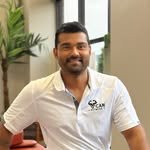
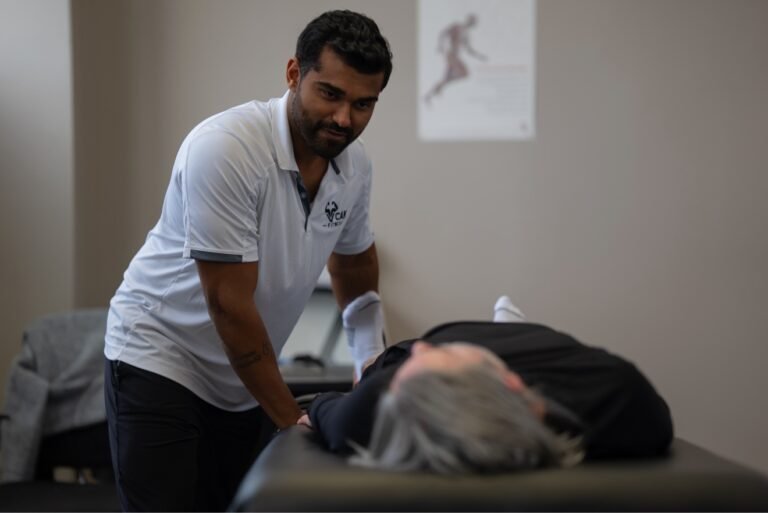
I am Vivek Pandya, a Certified Fascial Stretch Therapy practitioner — Level 2, trained through the Stretch to Win Institute — and I work one-on-one with golfers here in Williamson County. This is not a group stretch class and it is not you trying to copy a video in your living room. It is a calm, table-based session where I guide your body through its full, comfortable range while you relax and breathe.
The short answer
Assisted stretching for golfers uses Fascial Stretch Therapy to gently improve hip mobility, thoracic rotation, and shoulder turn — the three movements your swing depends on most. When your hips and mid-back rotate more freely, you can create a fuller turn, maintain posture longer, and often find easier distance without swinging harder.
Why golf swing hip mobility matters more than you think
Your golf swing is a rotation sport. Power does not start in your arms. It starts from the ground, moves through your hips, transfers through your trunk, and only then reaches the club.
When we talk about golf swing hip mobility, we are really talking about two things:
- Internal rotation of your lead hip in the follow-through
- External rotation of your trail hip in the backswing
If either side is tight, your body finds another way to turn. For a lot of the golfers I see in Brentwood, that compensation shows up as early extension, a sway or slide instead of a turn, or extra stress through the lower back and knees. I am not diagnosing anything here — I am simply watching how you move and where tension and tightness limit your turn.
At home, most golfers stretch their hamstrings and call it done. Hamstrings matter, but they are rarely the main limiter for rotation. Hip flexors that sit all week at a desk in Cool Springs, glutes that have gotten stiff, and fascia around the pelvis that has not been moved through a full range — those are the areas that usually change how a swing feels when we work on them properly.
In a Fascial Stretch Therapy session, we use gentle traction — a light pull that creates space in the joint — combined with slow, wave-like movement. That combination helps calm the stretch reflex, the protective response that makes solo stretching feel like it stops short. Because you are not forcing the stretch yourself, your nervous system tends to let go a little more, and we can explore range you already have but are not accessing on the course.
Thoracic rotation for golf: the turn you cannot fake
The second big piece is thoracic rotation for golf — rotation through your mid-back, the thoracic spine.
A good shoulder turn is not just shoulders. It is your rib cage rotating over a stable pelvis. If your mid-back is stiff from hours at a computer, driving on I-65, or years of limited rotation, your neck and lower back often try to do the extra work. That is when a swing starts to feel effortful, and your posture gets harder to hold through impact.
In session, we work on this in a few ways:
- Side-lying and supine rotations that let your trunk turn without loading your lower back
- Breathing-led movements — exhale as we rotate, so tension eases instead of bracing
- Shoulder and chest opening, so your lead shoulder can move across your body without pinching or pulling
I always keep this in tension, tightness, and mobility language, because that is what stretching can honestly address. I do not promise you will fix a slice or add a guaranteed number of yards. What clients do tell me, consistently, is that their turn feels less restricted, their warm-up is shorter, and they do not feel as stiff walking off the 18th green. For many golfers in Brentwood and Franklin, that alone makes the game more enjoyable.
If you want the bigger picture of how cost and first sessions work locally, I wrote a full guide here: Assisted Stretching in Brentwood, TN: Cost, Benefits & What to Expect (2026 Guide)
What a session for a golfer actually looks like at VCan Fitness
You stay fully clothed in comfortable clothing you can move in. You lie on a treatment table with a strap system that helps stabilize one side while we move the other — that stability is a key part of Fascial Stretch Therapy and part of what makes it different from general assisted stretching.
A typical 60-minute session for a golfer includes:
1. A quick movement check. We look at hip rotation left and right, how your trunk turns, and how your shoulders move. No complicated technology, just careful observation so we spend time where you need it most.
2. Hips and pelvis first. Hip flexors, glutes, deep rotators, and hamstrings — in an order that follows the fascial lines, not just isolated muscles.
3. Trunk and thoracic spine. Gentle rotations and side-bends to restore the separation between your hips and shoulders that creates coil in the backswing.
4. Shoulders, chest, and neck. Especially helpful if you feel tight at the top of your swing or stiff after a round.
5. A re-check. We revisit that same hip and trunk rotation from the start so you can feel the difference in the session, not just hope for it later.
Sessions are pain-free by design. We work to a point of gentle tension, never sharp pain, and you are in control the whole time. If something does not feel right, we stop and adjust.
Senior golfer flexibility — and why “senior” is the wrong frame
A lot of my golf clients are in their 50s, 60s, and 70s, playing at clubs around Brentwood, Franklin, and greater Nashville several times a week. I do not think of this as senior golfer flexibility as a separate category. I think of it as keeping the mobility you need to keep doing what you love.
As we age, fascia naturally becomes less hydrated and less elastic if we do not move it regularly. That does not mean you are supposed to feel stiff. It means regular, gentle, full-range movement matters more, not less.
For active older golfers, assisted stretching can help you:
- Warm up faster before a round, instead of needing nine holes to loosen up
- Maintain balance and posture through the swing as the round goes on
- Recover with less next-day tightness after playing or practicing
- Keep getting in and out of the cart, bending to tee up, and walking the course comfortably
None of this is about turning back the clock. It is about staying flexible, balanced, and independent on and off the course — the same goal I hear from almost every client over 50 who walks into Suite 227.
How often should golfers come in?
It depends on how much you play and how tight you feel right now.
- During season, playing 2–3 times a week: Once a week for the first 4–6 weeks, then every other week for maintenance is what many of my regulars settle into.
- Playing once a week or returning after a break: Every other week to start, with a re-check after a month.
- Before a golf trip or member-guest: A single session 1–2 days before you play can help you arrive feeling loose — not the day of a morning tee time if you have never been stretched before.
Consistency matters more than intensity. A gentle session you actually keep on your calendar will do more for your mobility than one aggressive session you never repeat. I will always be honest with you about frequency — if you are maintaining well, I will tell you that too.
Assisted stretching vs. stretching on your own before a round
Pre-round dynamic warm-ups are valuable and I encourage them: leg swings, trunk rotations with a club across your shoulders, and a few progressive practice swings. Keep doing those.
What assisted stretching adds is range you cannot easily reach alone, especially in the hips and thoracic spine, and the benefit of traction and stabilization while someone else does the work. Most golfers tell me they have stretched on their own for years and still felt tight in the same spots — that is often the stretch reflex limiting you, not a lack of effort.
Think of it this way: your warm-up prepares you for today. Fascial Stretch Therapy helps improve the mobility you bring to every warm-up.
Local proof: golf in Williamson County
I see golfers who play all over our area — from Brentwood and Cool Springs to Franklin and the wider Nashville courses. They are busy professionals, retirees who play three mornings a week, and parents trying to get 18 in on a Saturday without feeling wrecked on Sunday.
VCan Fitness is at 1648 Westgate Cir Suite 227, Brentwood, TN 37027, inside LUX Salon Suites. We serve Brentwood, Franklin, Cool Springs, and greater Nashville, with free parking right outside.
Your first visit can start with the $75 Move Freely intro (30 min, first-time clients) — a focused first session where we check your hip and trunk rotation and give you a clear sense of whether a full program makes sense for your game.
Call or text me at +1 615-998-8456 with questions, or book directly below.
One clear promise: I will never oversell you. If stretching is not the right next step for what you are feeling, I will say so and point you in a better direction.
FAQ: Assisted stretching for golfers
Will assisted stretching actually add distance to my drive?
I cannot guarantee distance — no honest practitioner should. What I can say is that when hip mobility and thoracic rotation improve, many golfers can make a fuller, more comfortable turn and maintain posture better, which are the mechanics that allow distance. Most clients first notice easier rotation and less tightness; distance, if it comes, follows from moving better, not swinging harder.
How soon before a round should I get stretched?
For your first session, come 1–2 days before a round so you know how your body responds. Once you know the work, many regulars like a session the day before they play. I do not recommend a first-ever deep stretch right before a morning tee time.
Is Fascial Stretch Therapy painful?
No. Sessions should feel like a gentle, deep stretch with traction — a sense of opening and release, not pain. We work within your comfortable range the whole time, and communication is constant. If you feel sharp pain at any point, we stop.
What should I wear to my session?
Comfortable athletic clothing you can move in — shorts, leggings, joggers, and a t-shirt are perfect. You stay fully clothed, and you do not need golf clothing or special shoes. Avoid jeans or restrictive clothing that limits hip movement.
I am over 60 and have not stretched in years. Is this safe for me?
For most active adults, gentle assisted stretching is appropriate, and we start conservatively with a movement check and your health history. This is not physical therapy and I do not diagnose conditions. If you have a recent surgery, injury, or a medical concern, check with your clinician first and tell me about it before we begin — we will adjust or postpone if needed.
How is this different from StretchLab or Stretch Zone?
Factual differences matter here. StretchLab uses PNF-based stretching with practitioners they call Flexologists, and offers both one-on-one and group formats. Stretch Zone uses its own proprietary method and strapping system. At VCan Fitness, you get one-on-one Fascial Stretch Therapy in a private suite, from a Certified FST practitioner (Level 2, Stretch to Win Institute), with a session built specifically around your hips, trunk, and shoulders for golf. Studios differ in method, setting, and pricing — the best fit is the one whose approach and environment you will actually stick with.
Do I need a package, or can I try one session?
Start with one. The $75 Move Freely intro (30 min, first-time clients) is designed exactly for that — try the work, feel the difference in your rotation, and decide from there. There is no pressure to buy a package in the session.
Ready to feel your turn again?
If your hips feel tight, your back gets stiff by the back nine, or your shoulder turn is not what it used to be, you do not have to just accept that as your new normal in golf.
Come in for a session at VCan Fitness, 1648 Westgate Cir Suite 227, Brentwood, TN 37027, and let us see what mobility you already have waiting to be accessed.
Book your $75 Move Freely intro or a full session here or call +1 615-998-8456.
I look forward to helping you move — and play — more freely.
— Vivek Pandya, Certified Fascial Stretch Therapy Practitioner – Level 2, VCan Fitness